Friday, January 20, 2012

TAFA

For the last year, or maybe more, I've been a member of TAFA (Textile and Fibre Art List) which was the brain child of Rachel Biel of Rayela Art.  It's been a really great resource for finding the very best textile artists from across the world.
Earlier in 2011 Rachel realised that the site (a very nice Blogger site) was getting rather too big, because there were over 400 artists listed.  So she set about talking to lots of people, and the members, to decide what to do about it.  The upshot is that she organised "Cloud" Funding and raised enough money to pay for a beautiful new site which is truly impressive.
As part of the site, Rachel has asked for a Members Forum so that we can talk to each other which should be a real asset to the group and I for one am looking forward to this development.
Please take a look at the list and have a good exploration of the profiles and products that this world wide community produce.  You'll not only be rewarded by seeing some of the very best textile artists in the world, but you will be amazed at the depth of skill there is in the group.

Friday, January 13, 2012

Colour & Weave


Colour & Weave, a set on Flickr.
Four scarves in Colour & Weave hand woven on a rigid heddle loom (Knitters Loom) in JC Rennie 2/11.3nm wool and cashmere.

Monday, January 02, 2012

Tip of the Month - January

There are some times when the quick warping method just doesn't cut the mustard - when you want a long warp or when you have some complex colour changes, for example.

First make a warp using the normal method on a warping board or warping mill and secure the cross as you usually would, then chain.
As well as your threading/fish hook and rigid heddle, you will need and extra stick.
You will also need to mark the width of your warp on the rigid heddle with a couple of bits of spare thread tied at the bottom of the appropriate slits.
All the loops will be dented in the rigid heddle on a table to prevent the spare stick from falling out of the loops.
Instead of using cross sticks, insert a loop of thread either side of the cross.


Place your index finger through the loom at the end of the warp.
 Ensure you can see the cross by spreading the warp within the loop.
 You should be able to see the the first thread, which may or may not be a single thread with a loop at the end.
Whether it's a singe thread or a double thread, pull it through the first slit and place on the spare stick.
As you get used to this method you will see the colour changes emerge in the correct order ready for denting in the rigid heddle.
You will usually have loops to put over the spare stick.
 But sometimes there will be knotted threads, where the colours were changed, you just have to be careful pulling these through the slits.
Keep going sliding the spare stick through all the loops as you go.
Once all the loops are through the slits they need to be secured to the spare stick.
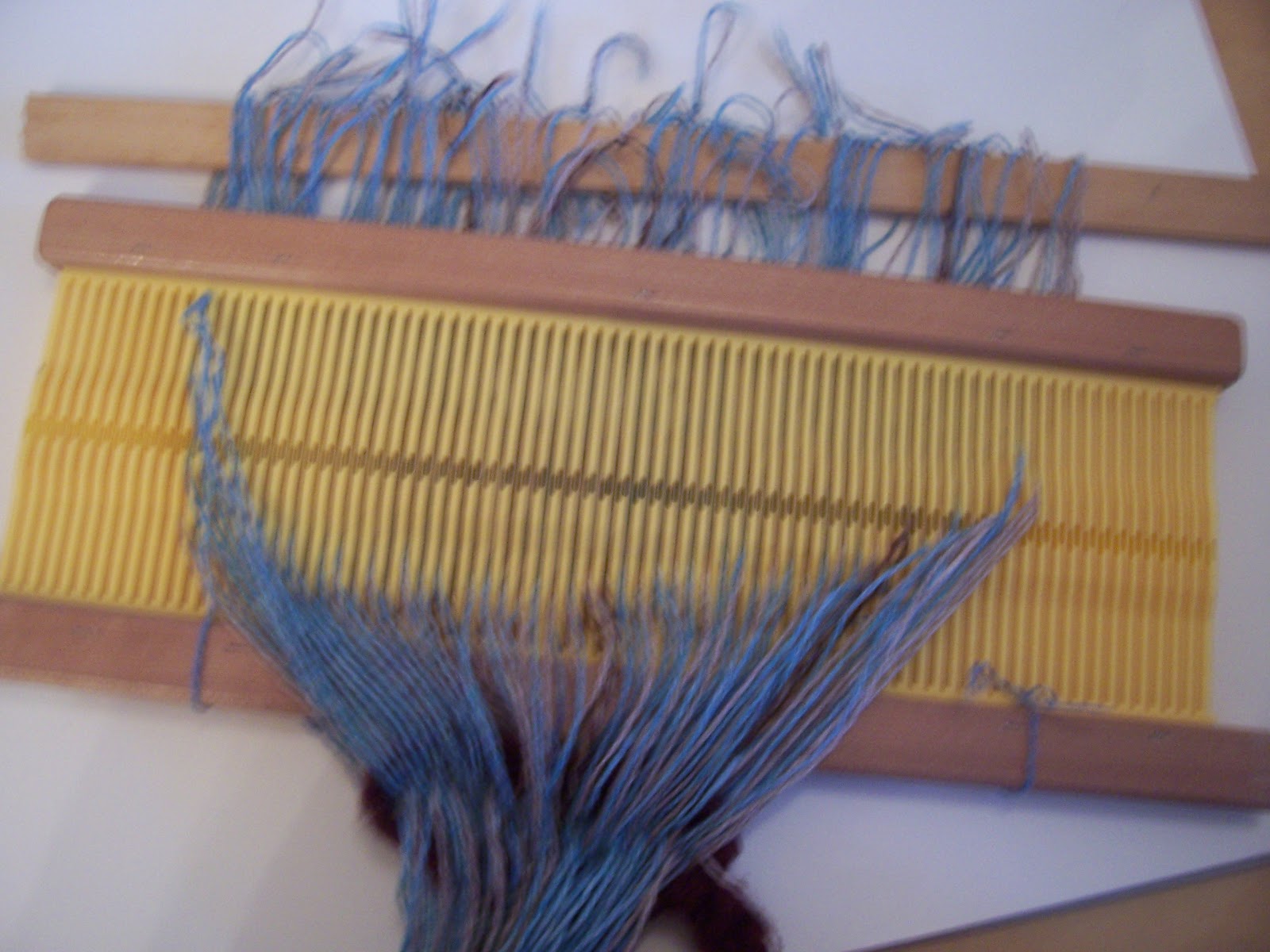
 Sorry this is a rather blurred image, but hopefully you can see that I've cut a long length of thread and doubled it.
Pass the two ends through the loop at the other end and put the spare stick through it, pulling tight.

Take the two ends and tie them at the opposite end of the stick.  If you've a stick with a hole at either end you can tie this string through the holes to secure the loops on the stick.
 If you don't have holes, ensure that the string is very secure by tying a number of times round the end of the spare stick.
Place the rigid heddle into the loom and the spare stick will need to be tied to the back warp stick.
You will need to loop several small pieces of string evenly across the the back warp stick.

Tie each one to the spare stick, either side of the loops and evenly across the warp.

All you need to do now is wind onto the back beam as usual.
Now you've wound onto the back beam, use your threading hook to transfer one the threads in the slit into it's adjacent hole, ensuring you keep the correct colour sequence.
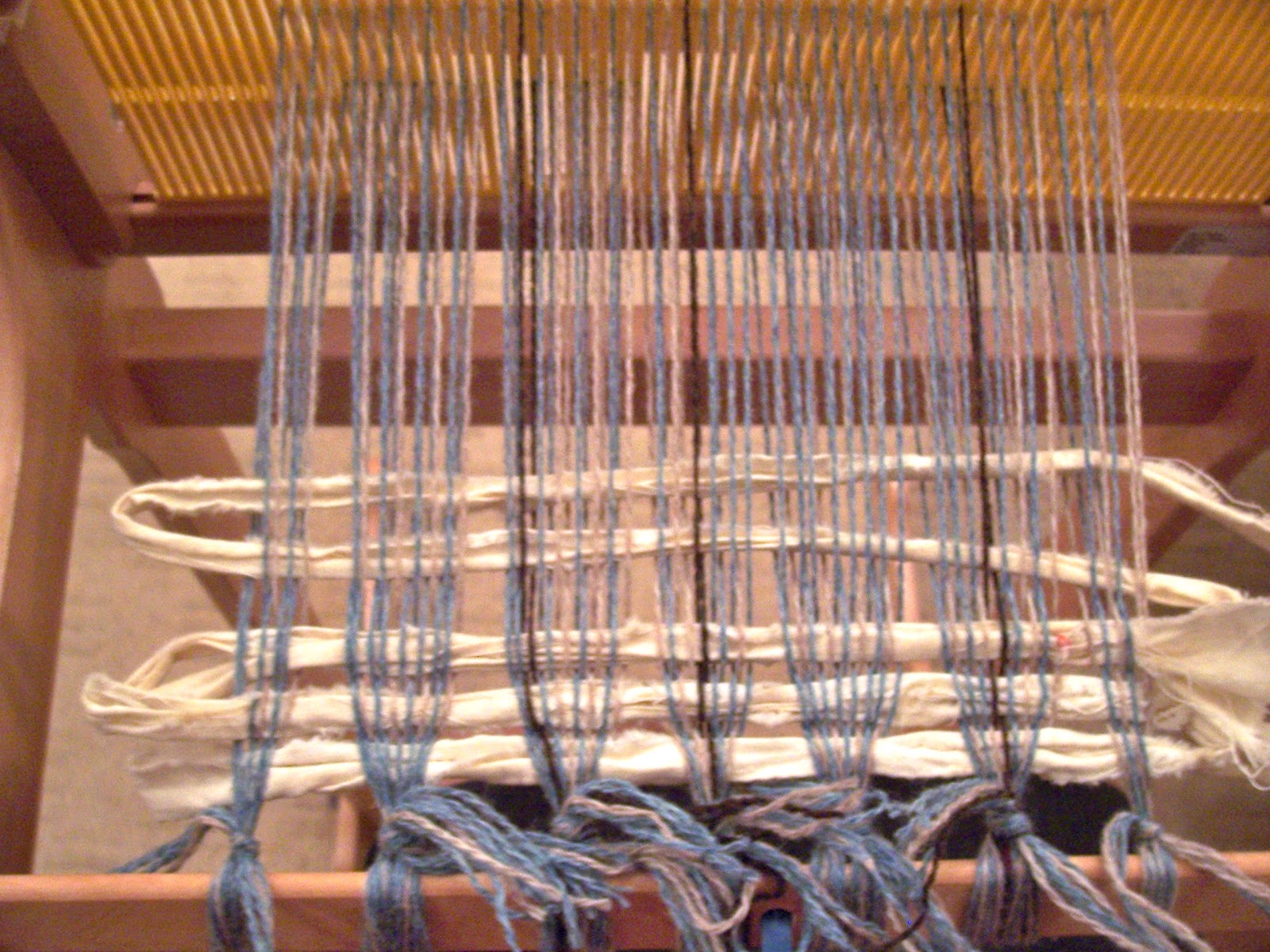
In this picture the first colour sequence, on the right is one light, one dark, followed by two threads of a completely different colour.  The next sequence is three dark and one light.

Sunday, December 18, 2011

Colour and Weave

About a year ago I had a small group of beginner weavers who wanted to move on with their rigid heddle weaving.  One of them was Jane Cowan, who has recently sent me a picture of her lovely rug, woven for her daughter on her rigid heddle loom.
Jane wanted to know it there was a book that could help her design different "patterns" on her rigid heddle.  After seeing this beautiful piece of weaving I suggested "Colour and Weave Design - A practical reference book" by Ann Sutton.  It's out of print now, but there are one or two second hand copies available and worth having in your library if you can get hold of one.

Saturday, December 17, 2011

Tip of the month - December 2011

I've been teaching quite a few rigid heddle workshops and courses recently,  mostly to new weavers, so I wanted to start a "tips" section on this blog in the hope it will be useful to all weavers, not just "newbies".
This month I had some lovely new people who had purchased new rigid heddle looms, could warp with the quick warping method and were getting along just fine.   One thing I did notice, though, was how they pack the warp at the beginning!  Some of the manufacturers suggest packing with card!  Such a lot of precious warp is wasted with this method, so I've been showing my students how to pack the start of the warp, to get the gaps filled quickly.
There are two types of packing I use, one is old thrums (the ends (threads) that's left at the end of a warp) which is something new weavers seldom have, and the other is long strips of fabric.
Even with a small square or rectangle of fabric you can cut long strips.
Take your fabric and cut 1" strips across the width, but not quite all the way across (see the image on the left).  This will give you a long strip which you can then use as your packing.

Fold the beginning of your strip so that it's just wider than your warp width and place in the shed.  Change your shed and from the same side of the warp, fold another section of your strip of fabric and place in this shed.
Beat each section of packing as you go and continue to add the packing until you find that the gaps between the bundles of warp ends are closed.


You will find with this method that the gaps close fairly quickly and that you waste much less warp.


Another nice thing is that the packing can remain in the warp until the cloth is finished and when you want to remove if, all you need to do is pull the first  the first piece of the strip and it all unravels nicely!

Saturday, November 19, 2011

November Colour Palette


This  month's colour palette is featuring Autumn colour, but not in the traditional sense.


I wonder why I like these colours for November?  Are they a palette that you would choose?
How would you use these colours?


Lots of questions, but lets not let our brains vegetate over winter (and that manic season that will soon be upon us!)


Thursday, November 03, 2011

New Niddy Noddy!

We've got a few new niddy noddy's for sale on our online shop
They are the most beautifully hand made niddy noddy's we've come across and are the creation of Nick Gant in Devon.


The Dam, which takes 1 metre per turn, is priced at £20 and the Lamb, a sample niddy noddy, is £15.  They will both be available from 14 November, so put the date in your diary, ready to order!


Left: The Dam in use.


Left: The Dam, in "flat pack" mode!

Wednesday, October 26, 2011

Sneak Peak 3

Here's my collage of the fungi I'm using for a tapestry workshop on Saturday.  Collage is a good way to introduce texture into your design process and starts to give you the feel of a textile.
With the colour and pencil textural studies you begin to feel closer to your design and ideas will now start to flow.

Friday, October 21, 2011

Sneak Peak 2

Not my usual style of painting, here, in oil pastel this time, but gave a better feel for the colours, still more work to do!

Beginning to get ideas for the tapestries and the woven shibori.  The tweed, well I love tweed, so that won't be too difficult, so more of that later.

Wednesday, October 19, 2011

Sneak Peak 1

You will probably recognise this image from the Colour Palette for October.  I selected an area of the image and cut it because I wanted to show the overlapping shapes of the fungi and the lovely ferns.

This is for three projects I'm working on...

To start, I'm designing a range of tapestries for a workshop I'm tutoring for Melbourne Arts Festival on Saturday 29 October.  We will be designing and weaving a small tapestry in a day.

I've registered for the Sketchbook Project 2012 and have chosen Stitches and Fold which has filled up already!  There's still time to sign up before the deadline of 31 October 2011, although you won't be able to pick Stitches and Folds.  This image immediately spoke folds, and I want to explore woven shibori and double cloth.

Finally, the colours are really really autumnal and would lend themselves to a beautiful tweed or suiting fabric, which I love designing, so that will be explored later.

On the left is a quick colour study in water colour and a rough textural sketch in pencil and charcoal.

So now you've seen my latest project I'll pop off and work on a collage next.
Watch this space...

Thursday, October 13, 2011

Colour Palette of the Month - October!

While I was looking through my image collection for this months inspiration I came across this image which was "snapped" in August, when we were exploring out new area.  During a walk we came across an old tree that had been blown over in the wind and in the hole where the roots had been a lot of bracket fungi were growing.

I was really taken with the autumnal colours, even in August, and the fern just set off the browns, yellows and ochres.

These colours are very "tweed" like and I could see this as a coat fabric with the lime green fern colour as an accent with lime green accessories!  What do you all think?


Sunday, September 11, 2011

Colour Palette of the Month - September

I'm afraid I missed last month, with our move, I completely forgot to post the palette I'd selected, so here it is now, for September!

The photograph was actually taken way back in March on our annual teaching visit to The Netherlands. The second part of the trip was down in Zeeland near Zierikzee where we had chance to visit the local beach.  It was a beautiful sunny, but blustery day and the beach was glinting in the sun, throwing shades of blue and terracotta between the stark white shells.

Thursday, September 08, 2011

Wool Week


Yes, it’s Wool Week, where we celebrate everything wool and the most interesting thing on the new this morning was the increase in the value of wool!
Since foot and mouth in 2001 the number of sheep have declined and as a result the value of the fleece have increased.  Most British wool is sent to the Wool Board and is destined for carpets, which is such a shame, as that leave very little for British craftsmen and designers like me.  I want British wool, we have the greatest and best range of sheep breeds and wool in the world which enables us to use the right wool for the right fabric.
I know someone who breeds a fabulous breed, the Bowmont, in Devon which rivals the best Merino and the whole clip is sold to make fine British base layer clothing for the active industry!  We need more of this fabulous breed here in the UK, so that more fleece is available.
The same person, organised the Exmoor Fleece Fair and I’m told by a textile designer friend that there was the most fabulous Exmoor Horn/Merino cross sheep who’s fleece was to die for and reputed to have a micro count close to 18, although it’s not been tested yet!   The organiser said that farmers where shocked that people were prepared to pay an extremely good premium for a quality fleece…  Yes, there are lots of us out there who want quality British fleece for fashion and interiors fabrics and most of us know quality when we see it!

Wool cushions
If you’re one of those people who believe that wool is coarse and itchy, then you’ve not tried Merino base layer underwear!  Take a look at the Campaign for Wool page and read about the benefits of wool.  The variety of wool is truly amazing from the softest to the coarsest, from the most lustrous to the dullest, and everything in between, there really is the most wonderful variety and you should find a breed or cross breed that is suitable for your needs.  We just need the farmers to produce the wool we want!

Wednesday, July 27, 2011

Creative Spinning at Alston Hall

I've just spent a very enjoyable week-end at Alston Hall with members of Bradford and District, Bowland and Craven Guilds of Weavers, Spinners and Dyers.  There were other guilds represented, too, and in my group there was a lady from as far away as East Sussex!

I had been tutoring a Creative Spinning workshop with consisted of 15 people including one man and a lady of 92, who was quite remarkable.  The week-end began with a wonderful meal provided by Alston Hall, followed by a group welcome, before heading off into our groups for an introduction.

Saturday began with a little light design work until lunch, consisting of colour studies, textural studies and collage before I'd let them try any spinning techniques.  After much hesitation and in some cases, sheer terror, everyone settled down to work and by tea time on Sunday had produced a huge amount of work and were starting to get the design bug.

Below are just a few images of the work that was completed, to see the full range take a look at the Creative Spinning Blog


Related Posts Plugin for WordPress, Blogger...