Showing posts with label balanced plain weave. Show all posts

Friday, April 17, 2020

Warping your Rigid Heddle Loom - Starting to Weave

The most common question I'm asked by beginners is how to keep the selvedges neat.  This post is intended to address this problem.

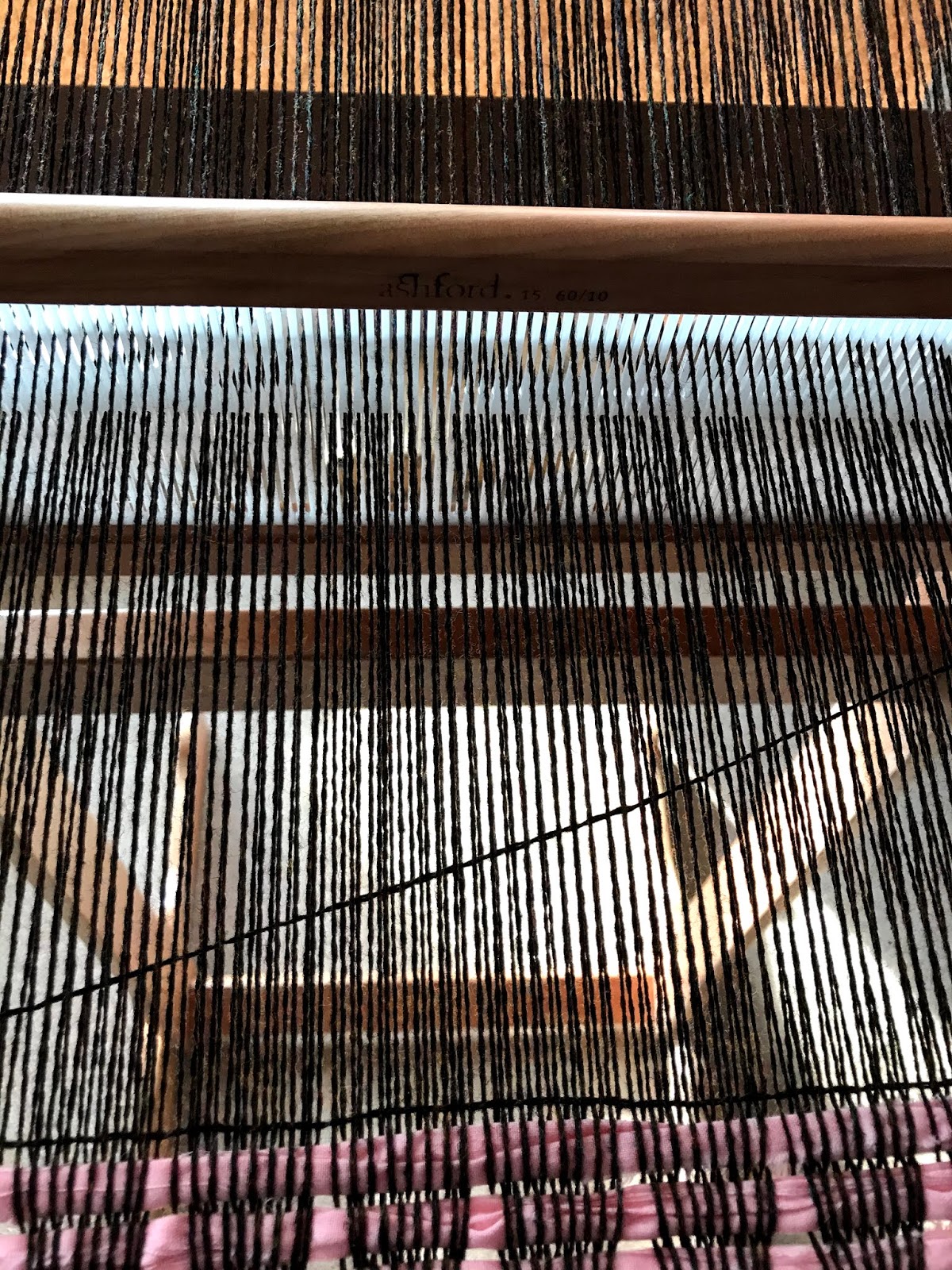
First and foremost the tying-on of your warp ends at the every edges, as we saw in Part 3, should help by ensuring that the start of the weaving is the right width to start.   The next thing is to ensure your weft is long enough to "mould" round the warp ends.  To do this lay your weft pick at 45 degrees.
Weft pick laid at 45degrees
In doing this you will find that there is enough additional weft to mould round the warp ends.  You can test this by holding the weft at the selvedge and bring it back to the fell of the cloth.  There will be about 1.5cm to 2.5cm (1/2" to 1") of weft to spare at the selvedge.  This would be how much the edges would pull in over the whole width of the weft.

The amount of weft to spare to mould round the warp ends, to prevent pull-in.
Very often there are loops at the selvedge, especially on a rigid heddle loom.  This is caused by the edge warps being at different heights as the weft turns round the selvedge.  To overcome this, hold the two adjacent warp ends at the selvedge at the same level, and at the same time give the weft a little tug to ensure it's sitting snuggly against the very edge warp end without pulling in.

Holding the two adjacent warp ends at the same level.
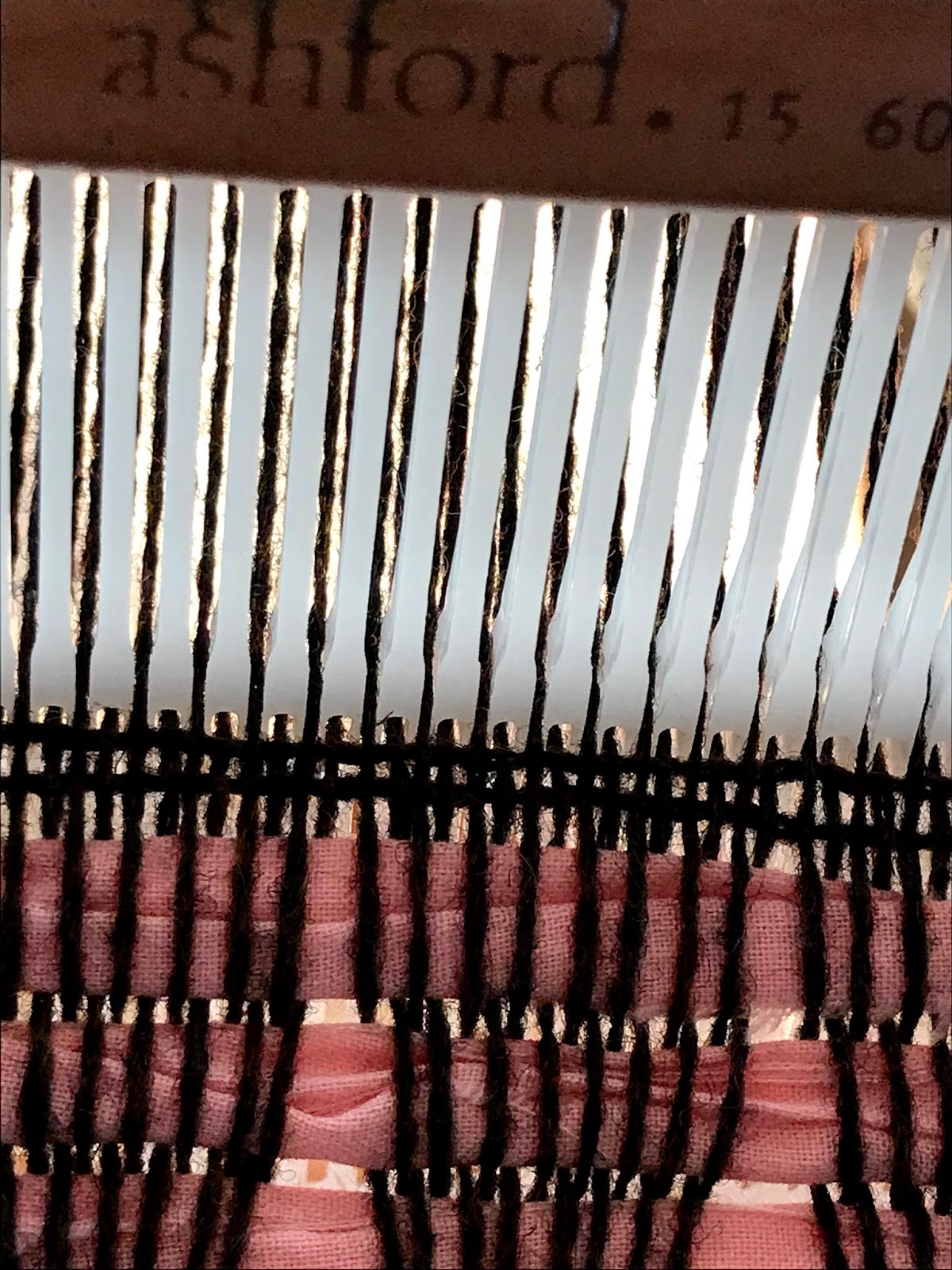
Once you've laid your weft at a 45 degree angle, gently ease the rigid heddle forward and watch the weft even itself out across the width of the warp.  You will see that it doesn't loop at the edge, but mould round the warp ends.  It's magic!

Watch the weft even itself across the warp as you gently ease it into position.
Although we say "beat" the weft into position, what we really mean is ease it into place.  You only need to "beat" the weft if you are making a rug and you need the warp ends to be covered completely to produce a weft faced weave.  For a balanced weave there should be equal warp ends and weft picks.  Two warps and two wefts should form a nice square when the weft is eased into position.  If you form a vertical oblong, you aren't beating enough, if it's an horizontal oblong your beating to much!
Two warps and two wefts should form a nice square.

Friday, October 08, 2010

Sett

or How to Work Out Which Yarn to Use with Your Rigid Heddle Loom

I've been asked how to work out whether a yarn is suitable for weaving on a rigid heddle loom and have been trying to explain about wraps to the inch.  I decided it was much better to do this via this blog!

On the right is an image of a yarn wrapped round a stick (this could be a pencil or pen or even straight round the ruler!).  You should see that it's been loosely wound so that the yarn isn't stretched, which would make the yarn narrower and give a false number of wraps.  There are 14 wraps to the inch with this yarn.


If you take a cross section of a balanced plain weave you will see  there are equal numbers of warp thread to weft threads.  So with our 14 wraps every wrap would alternate as either a warp or weft thread, so we can safely say that half the wraps would be warps and half would be wefts.
That would make 7 warps and 7 wefts = 14 wraps.
Therefore with 7 warps (S) we could use a 7.5 epi reed, the nearest in number to our yarn.

If a very open and softly draping shawl was being made we could go for a 5 dent reed or if we wanted firm upholstery fabric we might use a 10 dent reed.   We work this out by taking the wraps number, in this case 14, and divide it by 2 to get the sett for a balanced plain weave, 7 (S) here.  To allow for extra drape we can decrease that number by 5 - 10%, here that would be 0.7 at 10% which is approx. 1 end.  Take this from 7 (S) to give 6 ends, and you will see that the nearest reed is the 5 dent reed.

If you are using a slippery yarn to make a scarf, decrease S by 5% for drape but increase by 20% for slipperiness, a net increase of 15%.
For upholstery fabric increase S by 15 - 20% and beat very hard to obtain a balanced cloth.

I hope this helps!
Related Posts Plugin for WordPress, Blogger...